
This will be a bit arcane for most of you, but a major influence on the Dutch Calvinist philosopher, Herman Dooyeweerd, was Franz Xaver von Baader (1765-1841), whose work is now available online, albeit in difficult archaic German. J. Glen Friesen just emailed me the news that Google Books has digitized all 16 volumes of the Collected Works of Franz Xavier von Baader, the link to which is available at Friesen's website, along with links to several articles translated into English by Friesen.
[Hat tip to J.G.F.]
Wednesday, September 24, 2008
Wednesday, August 06, 2008
Theodore Plantinga - 1947-2008
 I take note of the passing of the philosopher, Theodore Plantinga (not to be confused with Notre Dame's Reformed philosopher, Alvin Plantinga), not only because of his particular contributions to the field of Dilthey studies and historical philosophy from his perspective as a Reformed Christian, but because of his personal assistance to me in my days as a doctoral student in helping me formulate my dissertation topic in such a way that it brought together my interest then in the Dutch Reformed phenomenologist, Herman Dooyeweerd, with parallel strands in the German phenomenological tradition adjacent to that of Dietrich von Hildebrand and Karol Wojtyla (Pope John Paul II) in Max Scheler and the critique he leveled against the classical ethical formalism of Immanuel Kant. The yield of this line of advice, years later, was my publication of Scheler's Critique Of Kant's Ethics
 , Continental Thought Series, V. 22 (Athens, OH: Ohio University Press, 1995).
 I never got to know Plantinga well, although I did read several of his books and articles, through which I gained considerable appreciation for his perspective and depth of analysis.
Here, in part, is how his university memorial reads under News and Events, "In Memoriam Professor Theodore Plantinga" (Redeemer University, Ancaster, Ontario, July 5, 2008):
It is with deep sadness that Redeemer University College announces the death of Dr. Theodore Plantinga, Professor and Chair of the Philosophy Department. Dr. Plantinga died peacefully at his home in Dundas on the evening of July 4, 2008 . Visitation will be held in St. James Anglican Church from 6:30 – 8:30 Tuesday evening (137 Melville, Dundas), and a memorial service will be held there on Wednesday at 1 pm.Plantinga spent the next quarter century as the chair of Redeemer's philosophy department during the institution's founding years. He also translated numerous books by Dutch authors into English, including volumes by the philosopher Herman Dooyeweerd. He also became managing editor of the Dooyeweerd Centre at Redeemer in 2005.
Theo Plantinga was born in 1947 in Ee, Friesland , the Netherlands . His family emigrated to Canada when he was four, settling in Winnipeg , where he attended elementary and secondary schools. He went to university at Calvin College in Grand Rapids, Michigan , where he received a B.A. in philosophy in 1969. He subsequently completed a Masters degree, and a Ph.D. in philosophy at the University of Toronto (1975). His doctoral dissertation, published by the University of Toronto Press in 1980, was Historical Understanding in the Thought of Wilhelm Dilthey.
During the next two years, Dr. Plantinga held a full-time position as lecturer in philosophy at Bishops University in Lennoxville, Quebec. Subsequently, he was a translator and managing editor for Paideia Press in St. Catharines, Ontario. He was appointed Executive Director of College Development for the Ontario Christian College Association, founded to explore the possibility of starting a Reformed Christian liberal arts and science college in Ontario.
The memorial concludes with these words: "He had a lively wit, a vibrant faith, a ready laugh, a listening ear and a particular fondness for the eccentric. He will be greatly missed as a friend, colleague, teacher and mentor. 'Precious in the sight of the Lord is the death of His saints.'"
[Hat tip to C.B.]
Wednesday, May 21, 2008
The young Scheler
 Mancuso Giuliana, Il Giovane Scheler (1899-1906) (Milano: Edizioni Universitarie di Lettere Economia Diritto, 2008).
 310pp.
€28,50
ISBN-13: 9788879163651
ISBN: 8879163655
Con la pubblicazione del Formalismusbuch e la proposta di un'etica materiale dei valori, Scheler si impose come esponente di punta della fenomenologia di impronta realistica. Tuttavia, egli aveva esordito sulla scena filosofica con una serie di scritti di impostazione neokantiana, e tale restò il suo quadro concettuale di riferimento almeno fino al 1906. Di questa fase giovanile ci si è occupati ben poco. Il neokantismo che informa la prima produzione scheleriana è rimasto una nozione vaga, non tematizzata in quanto tale. Il libro specifica questa nozione attraverso l'esame dei testi giovanili, dei loro più significativi debiti teorici e delle questioni teoriche in essi affrontate. Le risposte del giovane Scheler mostrano come il suo pensiero fosse radicato all'interno del paradigma inaugurato da Kant e sviluppato dal neocriticismo: un paradigma del quale egli accolse la strumentazione concettuale, pur problematizzandola, per lavorare dall'interno alle linee di tensione dell'impostazione trascendentale. L'analisi di due luoghi celebri della filosofia scheleriana della maturità coglie, infine, la presenza operativa di elementi teorici riconducibili al neokantismo giovanile.
Giuliana Mancuso (Carate Brianza, 1975) ha conseguito il titolo di Dottore di ricerca presso l'Università di Torino e attualmente è assegnista all'Università degli Studi di Milano. É autrice di traduzioni e saggi critici che hanno per oggetto la filosofia tedesca tra Ottocento e Novecento, con particolare attenzione al pensiero di Max Scheler, al neokantismo marburghese e alla fenomenologia.
Sunday, May 18, 2008
Foreclosure of homes and philosophy departments
Homes are being foreclosed at a fearsome rate these days, and it begins to look as though academic departments and programs are a similarly endangered species. I wrote a couple of weeks ago about the termination of the German Department at the University of Southern California, and on May 5, I noticed in The Chronicle that the University of Florida was terminating its doctoral program in Philosophy.Source: Stan Katz, "The Unity of Philosophy" (The Chronicle Review, May 14, 2008).
The university, confronting a substantial cutback in state appropriations, has announced that it will lay off 20 faculty members, among other steps, to reduce costs for FY2008-9. As part of this retrenchment, President Bernie Machen has also proposed reducing undergraduate enrollment and cutting back on research expenditures, as well as eliminating some degree programs.
I gather that other Florida universities are reacting similarly to dire state budgetary situations. Many states are experiencing exactly the same financial difficulties, and passing through their problems to public institutions of higher education.
[Hat tip to E.F.]
Monday, April 28, 2008
The celebrated Saul Kripke never earned more than a B.A.
 One of my good friends and readers of my blog wrote to me recently expressing his surprise that the world-class philosopher, Saul Kripke, was never educated beyond the undergraduate level. "Kripke decided to write and publish rather than take up graduate studies," he wrote. "What a guy!"
The Kripke personal story is indeed impressive and intriguing, as related by Charles McGrath in a New York Times article just after Kripke had turned 65 years old in November of 2005. The Graduate Center of the City University of New York convened a two-day conference on the occasion of his his birthday in celibration of the man and his work. "In many circles, Mr. Kripke, who in 2001 was awarded the Schock Prize, philosophy's equivalent of the Nobel, is thought to be the world's greatest living philosopher, perhaps the greatest since Wittgenstein," says McGrath -- except that Wittgenstein didn't do some of his most important work while still in high school.
Mr. Kripke, a rabbi's son, grew up in Omaha, and by all accounts was a true prodigy, so brilliant and precocious that the so-called prodigies of today are by comparison mere shadows flickering on the wall of our collective cave. In the fourth grade he discovered algebra, which he later said he could have invented on his own, and by the end of grammar school he had mastered geometry and calculus and taken up philosophy. While still a teenager he wrote a series of papers that eventually transformed the study of modal logic. One of them, or so the legend goes, earned a letter from the math department at Harvard, which hoped he would apply for a job until he wrote back and declined, explaining, "My mother said that I should finish high school and go to college first."Funny, how easy it is to forget. I remember working through parts of Naming and Necessity (1980) about twenty years ago, aware of its importance and significance as a major philosophical work. It's easy to assume that a work like that might have been written by a philosopher near the end of his career, or even by someone deceased for some time; but the fact is that Kripke was only 40 years old when he wrote it, and it was based on ideas he worked out when he was in high school, probably in the late 1950s. Since Kripke didn't waste any time on post-graduate schooling, dissertating and self-promoting, he was essentially able to complete what in effect the work of a spectacularly successful career by the time he was only 40, and he's been going strong for the 28 years since, with what appears to be as many years yet ahead of him. Setting aside the self-promotional shenanigans required of most graduate students in order to procure professional jobs, one is tempted to ask concerning the value of post-graduate education except as an inconvenient way of weeding out what the professional guild considers the candidates least likely to succeed. Yet one wonders how many Kripke's are forestalled by the prospect of having to endure six-years-to-a-decade of such nonsense before being allowed to settle down to the serious work of philosophical thinking.
The college he eventually chose was Harvard. "I wish I could have skipped college," Mr. Kripke said in an interview. "I got to know some interesting people, but I can't say I learned anything. I probably would have learned it all anyway, just reading on my own."
While still a Harvard undergrad, Mr. Kripke started teaching post-graduates down the street at the Massachusetts Institute of Technology, and after getting his B.A. didn't bother to acquire an advanced degree. Who could teach him anything he didn't already know? Instead, he began teaching and publishing. His 1980 book "Naming and Necessity," based on work he began in high school, is among the most influential philosophy books of the last 50 years ....
[Hat tip to E.F.]
Saturday, March 22, 2008
Memories of Dietrich Von Hildebrand
by Ronda Chervin, Ph.D.
It was truly a miracle that I met Gogo (as all his friends called him). Here is how it happened.[Ronda Chervin is presently an adjunct philosopher at Lenoir Rhyne College in North Carolina. For more information about her numerous books about Catholic living, as well as videos and audios, go to www.rondachervin.com. The present article is reproduced here by kind permission of the author.]
I was brought up as a total atheist, though my background was culturally Jewish. I studied philosophy hoping to find truth but only found skepticism, relativism, and historicism. I was looking for love but only found fascinating, sinful, disappointing relationships. By the age of 20 I was in despair of ever finding love or truth.
One Saturday my mother, who never surfed the TV, not ever, turned on the set in the middle of the afternoon, and there was a program called the Catholic Hour with two philosophers on it: Dietrich Von Hildebrand and Alice Jourdain. "Ronda, come see, there are some philosophers on TV." To my amazement, these philosophers were talking as if truth, love, goodness and beauty were objective realities.
I wrote them a long letter describing my futile search and asked if they could help me. It turned out that Alice (Lily – shortly afterwards to become Gogo's second wife) lived but 2 blocks away from me on the West Side of New York city. Neither she nor I, nor Madeleine (to be Stebbins) who was her roommate will ever forget our first meeting. Somehow, even though I was an atheist, I knew that there was something extraordinary in that apartment. Never had anyone looked into my eyes with such compassion and insight as did Lily. Afterwards, I danced down the street thinking, "I have met a saint."
Impressed by my yearning for truth, Lily suggested that I make a visit to the classes of Dietrich Von Hildebrand at Fordham and if I was enthusiastic, why not transfer my Woodrow Wilson scholarship from Johns Hopkins graduate school to Fordham.
Stephen Schwarz escorted me to Fordham. Two things caught my attention. The first was that, unlike the professors at Johns Hopkins who seemed to me to be dessicated academics, Von Hildebrand and Balduin Schwarz were vibrant men, overflowing with joy. Secondly I noticed that they could refute skepticism, relativism and historicism in a few sentences.
I like to think that two of my favorite saints also had something to do with the miracle of my mother turning on the TV at that moment: St. Therese of Lisieux who, during her dark night, prayed so much for atheists, and St. Edith Stein – who, having been an atheistic philosophy student from a Jewish background herself, surely she would want me to meet her "cousin" philosopher, Von Hildebrand.
Of course, being such a thoroughgoing atheist who had been brought up to think that all religious people were stupid and weak, I didn't think that the wonderful traits of Von Hildebrand, Lily, and the Schwarzs: Balduin, Leni (a convert from an atheist Jewish background) and Stephen, their son, had anything to do with their religion. I just wanted to be with them.
Zealous Gogo, at the urging of Lily, quickly arranged for my scholarship to be transferred and within a month I was taking courses at Fordham.
Ecstasy is the only word to describe my reaction to each of Gogo's classes, as I realized that truth was real, and what glorious truths, such as proofs that moral values were absolute. Simultaneously I was lapping up the love the members of the lay community surrounding me with. Getting to know them took place at lunches at the Schwarz house, and on the D-train of the NY subway from the Manhattan to the Bronx and back again, for I was able to travel a whole hour each way with either Gogo or Balduin who were riding up to the classes I was taking and they were teaching.
The miraculous events that led me to become a Catholic a year after meeting Gogo and Lily are told in my autobiography En Route to Eternity. A large part came from reading the authors recommended by them such as Augustine, Newman, and Chesterton. The night before my baptism I was visiting the Schwarzs who would become my godparents. Gogo was there. On my way home, I grabbed his arm and asked, "But suppose it isn't true, after all?" I expected some insight into philosophy or psychology of religion, but he replied with the simplicity of a peasant, "but think of the miracles!"
I found the personality of Gogo overwhelmingly. That the same man could be so serious, so deep, but also so spontaneous and affectionate, delighted me. We used to attend the same daily Mass, walking from different directions. Always I would find him singing opera loudly along the way. I often thought of this as the Italian side of his personality whereas the philosophical side was more German.
These personality traits of Gogo made whatever he wanted to teach me not so much didactic as enticing. And this was not only in the realm of philosophy. My father was a lover of classical music who filled our early childhood with the sound of music every hour he was home. As a teenager I rebelled and listened only to popular tunes. By college I gradually grew to love classical music, but had very little sense of choral music. I will never forget sitting in a room next to Gogo who was playing a 78 recording of Mozart's Laudate Dominum. To make sure I understood the beauty of it, he grabbed my arm with his hand and emphasized each climax of the singing with an extra squeeze accompanied by his radiant smile.
Another memory from these early days of the friendship, which would last until the end of his life, is of his insistence that those of us who rode with him on the subway from Fordham back to Manhattan pray Compline out loud in Latin. It was for me such an exemplification of the later buzz-word "counter-cultural" but also of freedom of spirit. In later years I followed his lead by insisting that friends pray the rosary aloud with me in airports during long waits at the gate.
Gogo played a large role in my marriage to Martin Chervin, a man from an orthodox Jewish background who had become an atheist as a teen but who wanted to know Christ. When I got interested in Martin as a possible spouse, I was on the verge of becoming a Catholic. At the time, he was a divorced playboy. I was confused. I thought a good way of getting rid of him would be to introduce him to Gogo and Lily and the Schwarz family. Surely they would tell me to drop this dangerous friendship immediately. Instead they all loved him and encouraged us in what turned out to be a long chaste courtship and helped us get a dispensation from Martin's previous non-religious marriage. We went through a long process with the New York and Roman tribunals. Finally Gogo was instrumental in persuading a prominent Cardinal to intervene for a dispensation in favorem fide.
It seemed as if Martin would soon become a Catholic. A major influence on him was the reading of Transformation in Christ. He recognized the genius of Gogo's combination of consummate understanding of human nature with sublime faith.
Even more, my husband, who had the same kind of joie de vivre as Gogo, could only have understood a faith like Gogo's, which included rejoicing in the goods of the earth, as well as opening to the redemptive gifts. Before meeting Gogo he thought of Catholics as either tight Puritanical types or rebellious sinners. It took him many years to finally become a Catholic, because he detested the American post-Vatican II Mass. Shortly before Gogo's death he made a bargain with God that should Gogo survive longer, at a time when his life seemed almost at an end, he would take it as a sign to become a Catholic in spite of his dislike of the English Mass. Gogo was spared a short time longer and Martin did become a Catholic
Gogo also had an influence on the conversion of my atheist mother. She was horrified at my interest in Roman Catholicism, but the personality of Gogo opened her to investigating the faith for herself. He decided to meet her informally at our home for individual teaching sessions to overcome her formidable doubts. In a charming gesture, the first time he came he presented her with a huge bouquet of peonies.
A few less important but telling memories:
Before his conversion, Martin and I were once traveling in Europe and went out of our way to go to Florence to see Gogo and Lily. I was praying constantly that whatever Gogo said would be a turning point for Martin to becoming a Catholic. We had a lovely visit but mostly the conversation was humorous and anecdotal instead of deep. At the end I was alone for a few moments and told Gogo how sorry I was that no important points had come up. Immediately Gogo's humorous expression changed to great seriousness and he exclaimed "What a sin on my part to have talked so much thoughtlessly!" I was touched by his readiness to acknowledge a fault even when it was unintentional.
Summers included a yearly meeting of a lay community that most of the Von Hildebrand circle were part of. I occasionally came to these meetings in Bavaria. The Mass was celebrated in a small chapel with parts of the congregation on either side – men on one side and women on the other. It always delighted me to see that, even after many years of marriage, Gogo could not bear to be separated from Lily – so throughout the Mass he would turn his head and gaze upon her with love.
A memory that fits with the name of the book The Soul of a Lion took place when Gogo and Lily came to Loyola Marymount University where I was teaching in the early 70's. Gogo gave the first talk. During the break, Lily told me that I must sit next to him while she was speaking and be sure that he stayed calm because he could have a fatal heart attack at any moment. During the question period the wife of a colleague of mine challenged Lily on some point. Gogo took it as an insult and tried to leap up to seize the floor. I grabbed him to hold him down. He turned on me swiftly and remarked: "Ronda, you can't keep me down. I am not a lamb, I am a lion."
We all knew that Gogo had a bad heart. Once, toward the end of his life, I had a nightmare that he was falling down a staircase to his doom. After that, whenever I was with him and there were stairs I pushed myself ahead of him so that I might cushion a fall.
As a professor of philosophy I have taught Gogo's books for decades with great impact. Some of my philosophy majors such as Michael Healy and James Harold, now at Franciscan University of Steubenville, went on to graduate school to study his thought. I cannot teach his ideas, or those of Lily, my life long friend, without a sense of the presence of their minds and hearts and souls permeating my smaller personhood. What a legacy. Viva the Von Hildebrands!
Thursday, February 28, 2008
Richard Rorty on Jacques Derrida having a bad day

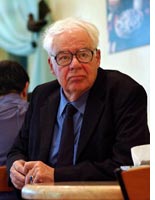 In his memorial, "Richard Rorty (1931-2007): In Memoriam" (CrossCurrents, Fall, 2007), John D. Caputo (right, pictured with white-haired Derrida) writes:
 Later on, I also took exception to what [Rorty, pictured left] said about Derrida, that Derrida was not just making fun of the great philosophers but he had an important philosophical project of his own. His response to that was equally gracious. Again, he did not contest what I said about Derrida but only mused that at those times when Derrida stopped making fun of philosophical theories and started developing positive philosophical theories of his own, Derrida was just having a bad day.[Hat tip to Dr. P.B.]
Saturday, November 24, 2007
Beatification of Rosmini: wonders never cease
 Sandro Magister, "Blessed Liberty: The Posthumous Miracle of Antonio Rosmini" (www.chiesa, November 12, 2007), writes:
ROMA, November 12, 2007 – A beatification ceremony is approaching that is a miracle in its own right: the beatification of the priest and philosopher Antonio Rosmini.Magister remarks: "The philosopher Dario Antiseri paints the portrait of this teacher of a form of liberalism open to religion." Rosmini fast tracked ahead of the Venerable John Henry Cardinal Newman?
It's a miracle because just six years ago, the new blessed was still under a condemnation issued in 1887 by the congregation of the Holy Office, against 40 propositions drawn from his writings.
Wednesday, November 21, 2007
The rediscovery of Dietrich von Hildebrand's legacy
Sue Ellin Browder, "‘Lost Treasure’: Catholic Colleges Recovering Von Hildebrand’s Philosophy" (National Catholic Register, November 4-10, 2007), writes:
[Hat tip to The Legacy Project Staff]
STEUBENVILLE, Ohio — John Henry Crosby is determined to revive interest in the thought of philosopher Dietrich von Hildebrand.That, my friends, is the substantial first half of the sizeable NCR article, which is well worth reading in its entirety. As a presenter at the recent von Hildebrand conference at Franciscan University and one who has discovered only relatively recently the philosophical breadth of the thinker, I heartily commend Mr. Crosby's Legacy Project to you.First persuaded by von Hildebrand’s reasoned arguments for the necessity of beauty, Crosby soon was caught up by the story of the philosopher’s heroic fight against Nazism and communism and his suspense-filled flight to freedom. The notion of a “brave philosopher” willing to put his life on the line for the truth inspired him.
“I’ll be involved with this until the day I die,” said Crosby, 29.
His enthusiasm for von Hildebrand is shared by none other than Pope Benedict XVI. As a priest in Munich in the 1950s, Father Joseph Ratzinger attended one of the lectures von Hildebrand often gave on his summer visits to Europe. The subject was “beauty.”
“The joy and freshness of [von Hildebrand’s] understanding of Catholic doctrine were contagious,” Cardinal Ratzinger wrote in 2000 in the foreword to The Soul of a Lion, Alice’s von Hildebrand’s biography of her late husband.
Cardinal Ratzinger believed the “transcendent beauty of truth” that had captured von Hildebrand’s heart was the “same love for the beauty of truth” that later led him to embrace and defend the magisterium’s teaching on birth control. He did so in a small volume originally titled The Encyclical “Humanae Vitae:” An Essay on Birth Control and Catholic Conscience, reprinted by Sophia Institute Press as Love, Marriage and the Catholic Conscience (currently out of print).
Characterizing von Hildebrand as “a man captivated by the splendor of truth,” Cardinal Ratzinger wrote: “I am personally convinced that, when, at some time in the future, the intellectual history of the Catholic Church is written, the name of Dietrich von Hildebrand will be most prominent among the figures of our time.”
The Legacy Project
To ensure that all the philosopher’s works will be available in English, Crosby has worked with Alice von Hildebrand and others to set up the Dietrich von Hildebrand Legacy Project (hildebrandlegacy.org).
Last month, the Legacy Project brought together more than 150 scholars and devotees from around the world for a conference at Franciscan University in Steubenville, Ohio. Scholars focused on von Hildebrand’s growing impact on Christian philosophy.
The philosopher’s impact is making itself felt, too, in university courses. At Steubenville the master of arts philosophy program is furthering von Hildebrand scholarship.
In support of the Legacy Project, Pope Benedict put through a $45,000 Papal Foundation grant to help fund the translation, publication and promotion of von Hilde-brand’s work.
[Hat tip to The Legacy Project Staff]
Sunday, November 04, 2007
The Turning of an Atheist
Mark Oppenheimer, The Turning of an Atheist (New York Times, November 4, 2007).
Of related interest: "Anthony Flew's newfound belief in God" (Musings, December 11, 2004).
Of related interest: "Anthony Flew's newfound belief in God" (Musings, December 11, 2004).
Wednesday, September 12, 2007
Ingwagen on the advantages of skepticism
Peter von Ingwagen, in God, Knowledge & Mystery: Essays in
Philosophical Theology (Ithaca and London: Cornell
University Press, 1995), on p. 2, writes:
Philosophical Theology (Ithaca and London: Cornell
University Press, 1995), on p. 2, writes:
One advantage philosophers bring to theology is that they know too much about philosophy to be overly impressed by the fact that a particular philosopher has said this or that. Philosophers of the present day know what Thomas Aquinas and Professor Bultmann did not know: that no philosopher is an authority. Philosophers know that if you want to pronounce on, say, the project of natural theology, you cannot simply appeal to what Kant has established about natural theology. You cannot do this for the very good reason that Kant has established nothing about natural theology. Kant has only offered arguments, and the cogency of these arguments can be (and is daily) disputed.This is, of course, amusing in one way; and I think I agree with in in the sense in which I believe he intends it. Yet I would disagree with the notion that no philosopher can properly be an authority, as, for instance, Aristotle is for St. Thomas Aquinas. This, of course, is what Ingwagen's quote would entail, if it were taken in the literal sense. Authority, I would argue, is something a bit like honor. You can be honored by others and not deserve it; and you can be dishonored by others and not deserve it. But when you get it right, you're honored by others because you've earned it by becoming worthy of their honor; and that worthiness is the important thing -- far more important than the actual honor given you by others. Accordingly, I would argue that it's possible for a philosopher (like Aristotle) to earn the right to be considered an authority -- whatever lack of consensus may exist within the contemporary fraternity of postmodern professional lemmings who call themselves philosophers. And a philosopher earnes this right by being worthy of being so regarded -- by becoming, in fact, an authority on a subject.
Saturday, September 08, 2007
Decadent postmoderns
For a scathing indictment of the existentialist philosophers, Jean-Paul Sartre and Martin Heidegger, and postmodern philosopher (I use the term loosely), Marcel Foucault, see Christopher's post, "Revolutionary Intellectuals" (Against the Grain, September 1, 2007). The discussion is occasioned by Gerald Augustinus' dismissal of Jean Paul Sartre at Closed Cafeteria (to which http://vox-nova.com/2007/08/31/whos-afraid-of-existentialism/) -- the former referencing Fr. Neuhaus' post Sartre, Legal Scholarship, and Those Troublesome Male Pronouns "On the Square") and the following excerpt from Clive James' Cultural Amnesia: Necessary Memories from History and the Arts. Complete with personal confessions of capitulation to the existentialist seduction and delicious quotes from Paul Johnson's wonderful book, Intellectuals, it's sure to provoke a plethora of responses.
Tuesday, July 17, 2007
Reformational Philosophy

 The Dutch Reformed tradition in philosophy -- often called "Reformational Philosophy" (not to be confused with the "Reformed Epistemology" of Alvin Plantinga, et al., which is an independent development in the Dutch Reformed tradition of Anglo-American analytic philosophy -- has produced a wealth of societies and journals and theorists stemming from Calvinistic tradition of Abraham Kuyper and Herman Bavinck and the seminal philosophical work of Herman Dooyeweerd (pictured left) and D.H.Th. Vollenhoven (pictured right) at the Free University of Amsterdam in the last century. Philosophical societies include the Stichting voor Reformatorische Wijsbegeerte (Society for Reformational Philosophy) and the professional journal, Philosophia Reformata. Other related sites include that of The Dooyeweerd Center for Christian Philosophy (Redeemer College, Ancaster, Ontario, Canada), Studies relating to Hermann Dooyeweerd (J. Glenn Friesen, Calgary, Alberta, Canada), Herman Dooyeweerd (Steve Bishop, Bristol, UK), The Dooyeweerd Pages (Andrew Basden, Salford, UK), Herman Dooyeweerd (1894-1977) (Philip Blosser, Lenoir-Rhyne College, Hickory, NC), and numerous other links. Of recent interest is the launching of a new electronic periodical, Aspects of Reformational Philosophy, Vol. 1 (2007), No. 1. Philosophers from a Catholic background may be interested in the work on Dooyeweerd by the Jesuit, Fr. J. Marlet, Grundlinien der Kalvinistischen "Philosophie der Gesetzesidee" als Christlicher Transzendentalphilosophie (Munchen: Karl Zink, 1954), which has interesting chapters comparing Dooyeweerd with St. Thomas Aquinas.
A number of sites promote the published work of the premiere Dutch Reformed philosopher, Herman Dooyeweerd. Among these one finds, for example, Steve Bishop's New Critique site, self-described as "A Guide to Dooyeweerd's New Critique of Theoretical Thought." This site offers introductory summaries not only of Herman Dooyeweerd's major philosophical work, the four-volume New Critique of Theoretical Thought (2nd ed., 1997)
- Vol 1: The Necessary Presuppositions of Philosophy
- Vol. 2: The Structures of Individuality of Temporal Reality
- Vol. 3: The General Theory of the Modal Spheres
- Vol. 4: Index of Subjects and Authors.
- The Christian Idea of the State, tr. John Kraay (1968)
- Christian Philosophy and the Meaning of History (Collected Works of Herman Dooyeweerd. Series B, Vol 1) (1997)
- Encyclopedia of Legal Science: Introduction (Collected Works of Herman Dooyeweerd) (2007)
- Encyclopedia of Legal Science: Historical (Collected Works of Herman Dooyeweerd) (2007)
- Encyclopedia of Legal Science: Systematic (Collected Works of Herman Dooyeweerd) (2007)
- Encyclopedia of Legal Science: Systemic (Collected Works of Herman Dooyeweerd) (2007)
- Essays in Legal, Social, and Political Philosophy (Collected Works of Herman Dooyeweerd. Series B, Vol 2) (2001)
- In the Struggle for a Christian Politics (Collected Works of Herman Dooyeweerd) (2007)
- Political Philosophy (Dooyeweerd, H. Selections. Ser. D, V. 1.) (2004)
- Reformation & Scholasticism in Philosophy (Collected Works of Herman Dooyeweerd) (2007)
- Roots of Western Culture: Pagan, Secular, and Christian Options (Collected Works of Herman Dooyeweerd Series B, Vol 3) (2003)
- Christian Theory of Social Institutions (Dooyeweerd, H. Works. V. 1.) (1986, currently unavailable)
- In the Twilight of Western Thought (1999)
- Introduction to Philosophy, ed. John H. Kok and Anthony Tol (2005)
- The Idea of a Christian Philosophy, Essays in Honour of D.H.Th. Vollenhoven (includes selected and annotated bibliography of Vollenhoven by K.A. Bril) (1973)
- Vollenhoven's Problem-historical Method: Introduction and Explorations, by Kornelis A. Bril, ed. by John H. Kok (2005)
Thursday, March 22, 2007
The gnostic temptation
I love the idea of theology as literary criticism. Much of literary criticism can be reduced to the explication of metaphorical language, or of the language of symbolism (which, with the flash and filigree removed, is only a more complex and challenging permutation of metaphor). The common denominator of both metaphor and symbol is the illusion that two separate things are actually one. With a simple metaphor, such deliberate confusion may amount to nothing more than a conceit, designed to highlight the cleverness of the author. With a symbol, however, a more complex statement is being made, the template of which is typically (1) A is not B, but (2) in a different and more profound way, A is B. The "more profound" way has to do with the cleverness of the author, of course, but also with his relationship with the reader: the author has set out in his text a deeper, more profound and elusive subtext, a hidden level of meaning which only the best prepared, most intelligent, most sensitive, most attuned, can fathom. It is a game of perspicacity, and also of exclusivity.
Thus, there is a certain gnostic tincture to literary criticism: a secret, "higher" knowledge which only the initiated can appreciate. The exquisite insights of Keats and Shelley are lost on workaday drudges, who prefer the ringside orations of WWF freaks of chemistry. The "quiet desperation" crowd is clueless before the altar of Shakespeare, and must wallow in the trashy cultural trough of soap operas and "American Idol" (and, as post-modernists might claim, the poor boobies don't even grasp the proper significance of that!)
But hark ye, a yet deeper layer. As the American university has transformed into a standard item of upper middle class accessorizing, many departments have had to staff up. The ability to teach is all well and good, but it has long been assumed by departmental pashas that performance and promotion has to be decided by more than just that: the basis for promotion in most English departments across the land is popularly referred to as "publish or perish", which means that you must demonstrate your attainment of the gnostic inner circle of knowledge by having your insights on a suitable topic accepted for publication in a book or a journal that is likely to be read only by other members of that inner circle. You must have your parchment placed in the gnostic Nag Hammadi, or face banishment to the bleak desert of the berber bourgeosie, where people actually perform manual labor for money, follow the doings of local sports teams, and watch the Fox Network – all willingly!
Quiet desperation indeed. And the effect of it has been to reduce literary criticism to an almost atomistic level of relativity – an incidental but absolute vindication of the postmodern thesis. My personal favorite example of this phenomenon is Moby Dick. Where once, not so very long ago, there was a fair amount of agreement about what was going on between Ahab and the white whale, today, Moby Dick resembles less a great work of literature than an abandoned strip-mine. The Bible, Shakespeare, Freud, Jung, John Calvin, Pierre Bayle, Spinoza, Schopenhauer, Zoroaster, the Ophites, Hindu mythology, Polynesian mythology, even Husserl – it is common, in piling yet another interpretational apparatus upon the novel, to extol the greatness of its symbolism as lying in its ability to "support" all of this gnostic dead weight. A true knee-slapper, that! The post-modern horselaugh in a nutshell: there is no deeper knowledge, no deepest layer: the Nag Hammadi parchments may as well be blank.
How marvellous, then, to see theologians behaving like literary critics! From Han Urs von Balthazar's radical inflation of Shakespeare's "all the world's a stage" into "all's a stage, period", to ressourcement fascination with the perfumed vitalistic metaphors of Blondel and Bergson, to Scott Hahn's promotion of the family as a suitable symbol for the triune God, to the current competitive "gnosticizing", if you will, over the proper reading of the metaphor of communio (why, for example, it is more than just a shiny new term for the pockmarked old one, "dialogue"), our "call to holiness" seems to lead so many of us into pursuit of one or another "white whale".
Wednesday, March 07, 2007
Habermas Writes to Pope Benedict XVI, ally against the "Defeatism" of Modern Reason
 Sandro Magister (www.chiesa, Roma, March 7, 2007): Habermas Writes to Ratzinger, and Ruini Responds. Allies against the "Defeatism" of Modern Reason -- "The famous atheist philosopher invokes a new alliance between faith and reason, but in a form different from the one Benedict XVI proposed in Regensburg. Cardinal Ruini highlights the points of agreement and disagreement. And he insists on “the best hypothesis”: to live as if God exists."
[Hat tip to M.F.]
Friday, December 29, 2006
Theology's Captivity to Continental Philosophy
R.R. Reno, associate professor of theology at Creighton University, has written a thoughful analysis of what he calls "Theology's Continental Captivity" (First Things, April, 2006, pp. 26-33). His thesis, essentially, is that contemporary theology has been taken captive by the continental tradition of philosophy, a tradition which in its contemporary postmodern recension is deeply inimical and corrosive of its own purposes, while ignoring the tradition of Anglo-American analytic philosophy, which could be most serviceable to its ends. Referring to trends in contemporary theology, he writes:
One of the first things one notes about the Existentialist tradition is that it includes both Christians (like Kierkegaard, Dostoevsky, Berdyaev, and Marcel) and atheists (like Nietzsche, Kafka, Camus, and Sartre -- though both Camus and Sartre were reverting Catholics at the end of their lives). The same polarity is evident in the subsequent movement of existential phenomenology, which includes both Christians (like Scheler, Jaspers and Ricoeur) as well as atheists (like Heidegger, Hartmann, and Merleau-Ponty). The Anglo-American analytic tradition is similarly checkered. Until the advent of Alvin Plantiga's "Reformed Epistemology" (belief in God as "properly basic") in the 1970s, it was dominated by agnostic and atheist evidentialists. Since that time, it is true, the Society of Christian philosophers and other such groups have produced a bugeoning discussion about Christian issues within the analytic tradition. One of the interesting results has been the debate between Catholic and Reformed Protestant philosophers over questions of religious epistemology, such as that sparked by Alvin Plantinga's Reformed Epistemology (cf. the anthology, Rational Faith: Catholic Responses to Reformed Epistemology, edited by Linda Zagzebski, University of Notre Dame Press, 1994).
In sum, I agree with Reno's critique of the disappointing and often nefarious fruits of the contemporary postmodern stepchildren of Heidegger and his fellow deconstructionists; however, I think it may be a bit too facile to suggest that the future and hope of Christian theology lies in looking to contemporary developments among Christian analytic philosophers as such. What of the current development in Protestant circles of the movement called Radical Orthodoxy? What of traditions of contemporary Catholic philosophy? What of the Polish movement of (phenomenological) Lublin Thomism? Realist Phenomenology? Personalism? What of the perspective of scholars such as Kenneth Schmitz? The new semiotic philosophy of John Deely?
Update 1/3/07 -- R.R. Reno responds:
Catholic or not, in the main it cannot see the apparent renewal of philosophy in the English-speaking world. Alvin Plantinga, Peter van Inwagen, William Alston, and the rest of the Society of Christian Philosophers can meet for twenty years, but theology remains blind to ways in which analytic philosophy can contribute to the “evangelization of culture” and renewal of theology that John Paul II—and now Benedict XVI—identify as singular imperatives in the West.I have little doubt as to Reno's general critique of the Heidegger and his stepchildren here, but less certainty about his prescription for harnessing theology to the horses of Anglo-American analytic philosophy. On the one hand, as profound as Heidegger's critical analytic of the western metaphysical tradition may be, it ultimately disappoints. Like the work of postmodern deconstructionists who followed him, it leaves one with nothing but the dismantled debris of disbelief. On the other hand, although significant figures have emerged from the ranks of the Anglo-American analytic tradition to make common cause with Christian theology, this is by no means a generalizeable feature of that tradition, any more than the supposition that all contemporary continental philosophers have been atheists. Some of the most outspoken opponents of the Christian "meta-narrative" and of foundationalist projects generally have emerged from out of the ranks of Anglo-American analytic tradition. Bertrand Russell, A.J. Ayer, and Richard Rorty come to mind. On the other hand, some of the most outspoken defenders of Christianity have emerged from the ranks of that continental tradition of Husserlian phenomenology in which Heidegger and his postmodern deconstructionist successors, such as the French Jacques Derrida, were themselves schooled. Dietrich von Hildebrand, Max Scheler, Edith Stein, Karol Wojtila, Robert Sokolowski, and Marold Westphal come to mind. So the first tentative inference I draw is that Reno's distinction may be precipitously overdrawn.
There are exceptions. Bruce Marshall’s Trinity and Truth assesses and reformulates the remarkable new philosophical resources developed since Quine lead analytic philosophy out of its epistemological captivity. Marshall’s colleague, William Abraham, works out of the analytic tradition. There are self-described analytic Thomists. The late Donald Mackinnon helped his theological students see the value of analytic philosophy. But by and large, these figures and trends are eccentric to the main body of contemporary theology. The overwhelming majority of theologians today sift through Heidegger and his philosophical children and grandchildren to try to find useable material.
This impulse is understandable but misguided. Heidegger and his progeny have developed into a tradition unsuited to the traditional role of philosophy has played in Christian intellectual life. It has little to offer for the task John Paul II thought so pressing, to renew confidence in reason, and it does more harm than good in the technical work of systematic theology. (emphasis added)
One of the first things one notes about the Existentialist tradition is that it includes both Christians (like Kierkegaard, Dostoevsky, Berdyaev, and Marcel) and atheists (like Nietzsche, Kafka, Camus, and Sartre -- though both Camus and Sartre were reverting Catholics at the end of their lives). The same polarity is evident in the subsequent movement of existential phenomenology, which includes both Christians (like Scheler, Jaspers and Ricoeur) as well as atheists (like Heidegger, Hartmann, and Merleau-Ponty). The Anglo-American analytic tradition is similarly checkered. Until the advent of Alvin Plantiga's "Reformed Epistemology" (belief in God as "properly basic") in the 1970s, it was dominated by agnostic and atheist evidentialists. Since that time, it is true, the Society of Christian philosophers and other such groups have produced a bugeoning discussion about Christian issues within the analytic tradition. One of the interesting results has been the debate between Catholic and Reformed Protestant philosophers over questions of religious epistemology, such as that sparked by Alvin Plantinga's Reformed Epistemology (cf. the anthology, Rational Faith: Catholic Responses to Reformed Epistemology
, edited by Linda Zagzebski, University of Notre Dame Press, 1994). In sum, I agree with Reno's critique of the disappointing and often nefarious fruits of the contemporary postmodern stepchildren of Heidegger and his fellow deconstructionists; however, I think it may be a bit too facile to suggest that the future and hope of Christian theology lies in looking to contemporary developments among Christian analytic philosophers as such. What of the current development in Protestant circles of the movement called Radical Orthodoxy? What of traditions of contemporary Catholic philosophy? What of the Polish movement of (phenomenological) Lublin Thomism? Realist Phenomenology? Personalism? What of the perspective of scholars such as Kenneth Schmitz? The new semiotic philosophy of John Deely?
Update 1/3/07 -- R.R. Reno responds:
Dear Phil,Note: For comments in progress on this article, please go to the comment box for Musings of a Pertinacious Papist, December 29, 2006.
Many thanks for contacting me and directing my attention to the discussion of Continental Captivity.
As I step back and think about the many discussions I have had since the article appeared, one thought (or perhaps cluster of thoughts) keeps coming back to me. The decisive figure in modern European intellectual life was Hegel. He saw that the “picture” of human existence provided by Christian teaching needed to be superseded by the “concept” of human existence provided by theology. To do so, theology takes a subordinate place within the overarching competence of modern intellectual life, as the final section of the Phenomenology clearly (and with remarkable contemporary relevance) shows. Or as my article says, with Hegel, born of an elite culture that could not longer affirm the ultimacy of Christian teaching, European philosophy reverts to the original, theological form of Hellenistic philosophy: theology and cure of the soul. Hegel was a conservative. He wanted to preserve the phenomenological core of the Christian worldview. Others were more radical. But what makes Continental philosophy distinctive is its collective “hermeneutical” agenda — it wishes to interpret us to ourselves. Again, this is a recovery of the ancient promise of philosophy — it will bring us to know ourselves, and in knowing ourselves, into participation with that which is lasting. Such a view of the vocation of philosophy cannot but collide with theology.
One of the folks commenting on your post wrongly portrays St. Augustine’s encounter of Cicero’s Hortensius as a step forward on the journey to God. In Book Eight, St. Augustine reports that it was Ponticianus’ story of the power of St. Antony’s biography that brought him to the painful fulfillment of the Socratic imperative: know thyself. “You took me up from behind my own back where I had placed myself because I did not wish to observe myself,” Augustine writes of the visit by Ponticianus, “and you see me before my face so that I could see how vile I was, how twisted and filthy, covered in sores and ulcers.” In this state of self-knowledge, St. Augustine reports that his enthusiasm for philosophy born in his youthful reading of Cicero bore no spiritual fruits — it only shifted his self-love from material indulgence to the labyrinths of an intellectualized self-conceit. Thus he observes in Book Six how astounded he was to discover that what he had imagined a momentous new beginning as a nineteen year old was, in fact, a long detour of delays and self-deceptions.
Compare the failure of philosophy to cure his soul with Book Nine. There, the ideals of classical philosophy are portrayed as realized and fulfilled through his recitations of the Psalm. The Psalms are the language of transformative self-knowledge. By reciting the Psalms, Augustine writes, “I was expressing the most intimate feelings of my mind with myself and to myself.”
One of the great achievements of medieval intellectual culture was its full use of the cognitive potential of classical philosophy within the spirit of the Augustinian critique of its failed promises of personal transformation. Medieval theology domesticated philosophy (handmaiden!), and in so doing, claimed to realize its true potential, both as a world-focused instrument for an ever more accurate picture of finite reality, and as a discipline of mind and spirit that prepared one for full reception of the gospel.
When I wrote the essay for First Things, I tried to provide an accurate assessment of how different modern philosophical traditions might relate to this medieval achievement. Perhaps I am mistaken. Surely a popular essay cannot do justice to the complexities of continental or analytic philosophies. But I would ask readers of my essay to read Hillary Putnam’s recent book, Ethics without Ontology
Thanks again,
Rusty
Saturday, November 11, 2006
Ronald Knox on Bishop Berkeley
There was a young man who said, "God,[cited in James L. Cox, A Guide to the Phenomenology of Religion (London: T&T Clark, 2006), p. 13]
I find it exceedingly odd
That this tree I see should continue to be
When there's no one about in the Quad."
Reply.
"Dear Sir:
I am always about in the Quad.
And that's why the tree
Will continue to be
Since observed by
Yours faithfully,
God."
Monday, October 30, 2006
Society for the Defenestration of Television Sets

 Jerry Mander, Four Arguments for the Elimination of Television,
 Neil Postman, Amusing Ourselves to Death: Public Discourse in the Age of Show Business
,Jane M. Healy, Endangered Minds: Why Children Don't Think And What We Can Do About It
,Marie Winn, The Plug-In Drug: Television, Computers, and Family Life
.
Saturday, October 28, 2006
 "If somebody has a bad heart, they can plug this jack in at night as they go to bed and it will monitor their heart throughout the night. And the next morning, when they wake up dead, there'll be a record."
 Mark S. Fowler, FCC Chairman
Feeling any better?
Tuesday, August 15, 2006
Protestant converts and ironies among phenomenologists
We've all heard about the Catholic converts from among the ranks of the phenomenologists -- Edith Stein, Dietrich von Hildebrand, and (on a bit shakier ground) Max Scheler, etc. But how many of us have heard about the Protestant converts?
While in grad school, I had heard several rumors that the father of phenomenology, Edmund Husserl himself had converted to the Christian faith before his death, but no definite details. There was some mention about conversation between him and a nun on his deathbed. But these last details may have been apocryphal.
 What I did discover last year, however, through a generous contact, was that Husserl had converted to the Lutheran faith; and it was hardly on his deathbed. Here is a quotation from an online Biography:
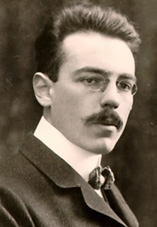 Another interesting conversion is that of Adolph Reinach (pictured left), who was of Jewish ancestry, converted to the Lutheran faith, but apparently a lapsed Lutheran for most of his life (Evelyn Waugh called him an "apostate Lutheran" in his 1952 review of a biography of Edith Stein). However, he evidently returned to his Lutheran faith while in the army before he was killed in action. In another twist of Providence, his widow, Frau Reinach (who later became a Catholic), by the resignation and hope with which she accepted her husband's premature death, was instrumental in shedding significant light on the significance of the experience of the Christian faith for Edith Stein, who had agreed to organize Reinach's unpublished manuscripts.
 Finally, as to ironies, Thomas S. Hibbs, in his splendid review of Alisdair MacIntyre's magisterial Edith Stein: A Philosophical Prologue 1913-1922 in First Things (May 2006), entitled "The Beginning of the Journey," notes how MacIntyre points out in his book the intriguing parallels and differences between Stein (pictured right) and Heidegger (below):
While in grad school, I had heard several rumors that the father of phenomenology, Edmund Husserl himself had converted to the Christian faith before his death, but no definite details. There was some mention about conversation between him and a nun on his deathbed. But these last details may have been apocryphal.
What I did discover last year, however, through a generous contact, was that Husserl had converted to the Lutheran faith; and it was hardly on his deathbed. Here is a quotation from an online Biography:1886-7 was a pivotal year for Husserl. He moved to Halle, and studied psychology, writing his Habilitationsschrift, entitled, The Philosophy of Arithmetic. He converted to Christianity along with his fiancé and member of the Prossnitz Jewish community, Malvine Charlotte Steinschneider. They had three children together. (emphasis added)Furthermore, on page 15 of a book titled Husserl-Chronik by Karl Schuhmann (Martinus Nijhoff, 1977), Husserl's baptism at a Lutheran church in Vienna is reported as having occurred on April 26, 1886:
"Husserl wird in der Stadtkirche der evangelischen Pfarr gemeinde Augsburgischen Bekenntnisses zu Wien auf den Namen Edmund Gustav Albrecht Husserl getauft. Als Pate fungiert Dr. Gustav Albrecht, Gymnasiallehrer in Maehrisch-Treubau."Again, on p. 16 of the same book, one reads: "Unter dem Einfluss Masaryks ging H. zum Protestantismus ueber" (Translation: "Husserl turned to Protestantism under the influence of Masaryks").
Translation: "Husserl was baptized under the name of Edmund Gustav Albrecht Husserl in the town church of the evangelical Pfarr municipality of the Augsburg Confession in Vienna. Dr. Gustav Albrecht, a teacher at he Gymnasium in Maehrisch-Treubau, served as his godfather."
Another interesting conversion is that of Adolph Reinach (pictured left), who was of Jewish ancestry, converted to the Lutheran faith, but apparently a lapsed Lutheran for most of his life (Evelyn Waugh called him an "apostate Lutheran" in his 1952 review of a biography of Edith Stein). However, he evidently returned to his Lutheran faith while in the army before he was killed in action. In another twist of Providence, his widow, Frau Reinach (who later became a Catholic), by the resignation and hope with which she accepted her husband's premature death, was instrumental in shedding significant light on the significance of the experience of the Christian faith for Edith Stein, who had agreed to organize Reinach's unpublished manuscripts.Finally, as to ironies, Thomas S. Hibbs, in his splendid review of Alisdair MacIntyre's magisterial Edith Stein: A Philosophical Prologue 1913-1922 in First Things (May 2006), entitled "The Beginning of the Journey," notes how MacIntyre points out in his book the intriguing parallels and differences between Stein (pictured right) and Heidegger (below):At various points,Simply amazing!MacIntyre offers tantalizing comparisons of Stein and Heidegger, whose lives have intersecting but opposed trajectories. Heidegger began as a Catholic, studied with Husserl, abandoned Husserl to embark on a radical deconstruction of traditional metaphysics, and ended up an ally of the Third Reich. Edith Stein began as a practicing Jew, turned to atheism, studied with Husserl, struggled to move beyond the limitations she detected in Husserl’s phenomenology, became a Catholic, moved toward traditional metaphysics, and was executed by the Nazis at Auschwitz.
Subscribe to:
Comment Feed (RSS)